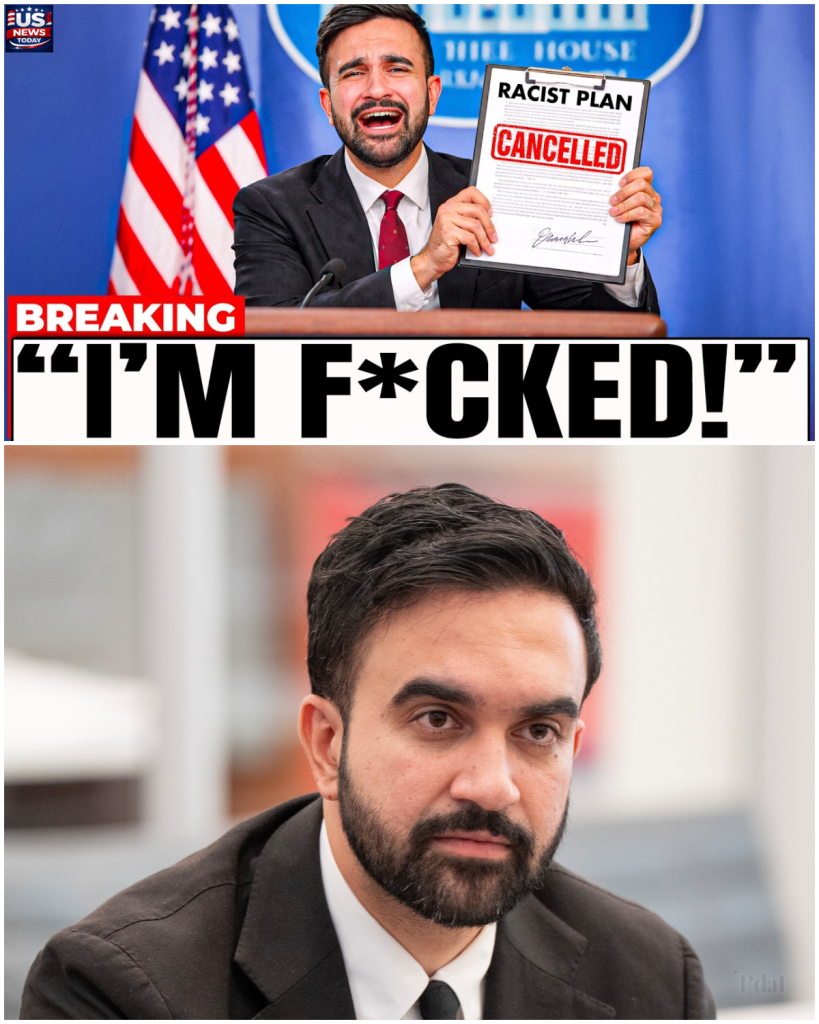
MAMDANI GOES NUTS As DOJ JUST DESTROYED His Racist Plan!🛑🛑
New York City Mayor Zohran Mamdani’s preliminary racial equity plan, intended to address long-standing disparities, has instead triggered immediate and intense backlash, drawing scrutiny from political opponents and federal authorities.
Legal experts are now examining the plan’s implications. At its core, the proposal is ambitious in scale, spanning hundreds of pages and outlining hundreds of goals, strategies, and performance indicators across dozens of city agencies.
On paper, it represents a data-driven attempt to address systemic inequalities through coordinated government action. Supporters argue that such an approach is necessary in a city where disparities in income, housing, and access to resources have persisted for decades.
Yet the reaction has been swift and deeply divided. Critics have zeroed in on elements of the plan that they interpret as prioritizing race in ways that could conflict with constitutional principles.
DOJ Scrutiny and Legal Challenges
The controversy intensified when a senior official from the U.S. Department of Justice publicly indicated that aspects of the plan may warrant review, signaling the possibility of legal challenges that could shape not only this policy but similar initiatives nationwide.
One of the most contentious aspects of the debate revolves around taxation. Discussions about shifting tax burdens—particularly language referencing wealthier neighborhoods—have been interpreted by opponents as an attempt to redistribute based on racial demographics.
Legal scholars note that while governments can design tax systems that address inequality, explicitly tying such policies to race raises serious constitutional questions under the Equal Protection Clause.
Mamdani’s Defense and Economic Realities
Mamdani, however, has defended the framework as an effort to correct imbalances in how resources and burdens are currently distributed.
His administration points to data showing significant disparities in wealth across different communities, arguing that any meaningful solution must account for those realities. In this view, the plan is not about division, but about addressing structural conditions that have produced unequal outcomes over time.
Complicating the situation further is the broader economic backdrop. The city is facing a severe affordability crisis, with a significant portion of residents struggling to cover basic expenses such as housing, food, and childcare.
This reality has become central to the criticism, with opponents arguing that policies perceived as complex or divisive may fail to address the immediate financial pressures facing everyday New Yorkers.
The Intertwined Nature of Race and Economics
At the same time, Mamdani’s supporters counter that economic hardship does not affect all communities equally. They argue that race and economics are often intertwined in ways that cannot be ignored, and that policies aiming for neutrality may inadvertently perpetuate existing disparities.
From this perspective, the equity framework is an attempt to confront uncomfortable truths rather than avoid them.
Inside City Hall, the tension is reportedly just as real. Legal advisors have raised concerns about how certain elements of the plan could be interpreted in court, leading to adjustments in language and presentation.
Political Ramifications and Public Trust
This internal caution reflects the broader uncertainty surrounding how far race-conscious policymaking can go within current legal boundaries, especially in light of recent judicial decisions that have taken a more restrictive view of such approaches.
Beyond the legal debate, the political ramifications are already unfolding. Mamdani’s coalition appears to be facing pressure from multiple directions.
Progressive supporters are urging him to remain committed to transformative change, while moderates and independents are expressing concern about potential overreach. Business leaders, meanwhile, are watching closely, particularly in relation to tax policy and its potential impact on investment and economic stability.
The Challenge of Governance
Public perception is becoming a decisive factor. In a city as diverse as New York, policies that are seen as favoring one group over another—regardless of intent—can quickly become flashpoints.
The challenge for any administration is not only to design effective policies but also to maintain broad public trust, a task that becomes significantly harder in a polarized environment.
At the heart of the issue is a fundamental question about governance: how to address inequality without creating new forms of division. It is a question that extends far beyond New York City, touching on national debates about the role of government, the meaning of fairness, and the limits of policy in solving deeply rooted social problems.
Uncertain Future and Lasting Debate
The situation is further complicated by the gap between long-term vision and immediate need. Large-scale frameworks often aim to produce change over years or decades, but residents experiencing financial strain today may be looking for more immediate relief.
Bridging that gap—between aspiration and implementation—is one of the most difficult challenges any administration can face.
As scrutiny intensifies, the future of the plan remains uncertain. Legal challenges could reshape or halt key components, while political pressure may force revisions or recalibrations.
What is clear, however, is that the debate it has sparked is not going away. It has opened a broader conversation about how cities confront inequality and what trade-offs they are willing to make in the process.
In the end, the outcome will likely depend not only on legal rulings or political strategy, but on whether the administration can align its goals with solutions that resonate across a wide spectrum of residents.
Without that alignment, even the most comprehensive plans risk becoming disconnected from the people they are intended to serve.
New York City has long been a place where bold ideas are tested against complex realities. Mamdani’s racial equity plan is now facing that test in real time, under the scrutiny of courts, critics, and the public alike.
Whether it emerges as a model for change or a cautionary tale will depend on how these tensions are resolved in the weeks and months ahead.
This story has been updated. celebbnews.info’s Staff contributed to this report.