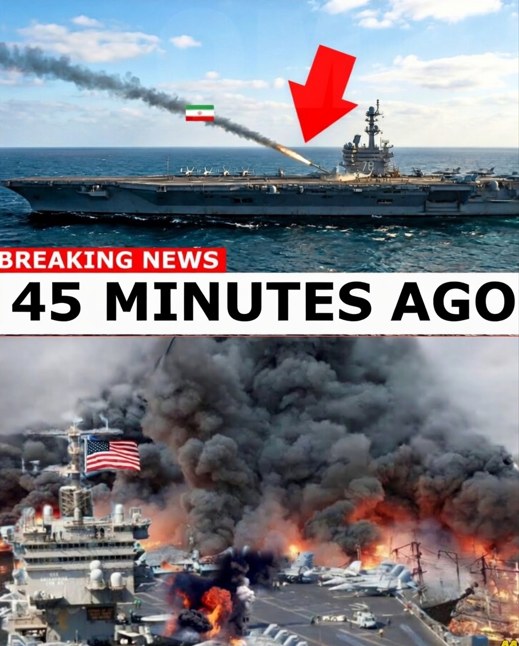
🌊Iran Fired 8 Deadly Missiles at a U.S. Aircraft Carrier — America’s Response Was…
In a high-stakes scenario in the Arabian Sea, the USS Gerald R. Ford faces a lethal threat from eight incoming missiles launched by Iran. While the Aegis Combat System attempts to neutralize the swarm, it struggles to differentiate between seven sophisticated decoys and a single Khorramshahr missile warhead packed with 1,500 kilograms of high explosives. As the ship’s inventory of interceptor missiles is exhausted, two targets remain on a collision course, pushing the most advanced United States Navy aircraft carrier to the brink of a near-catastrophic confrontation.
The crisis turns on the intuition of Lieutenant Rachel Webb, who identifies a minute 0.3 percent variation in an exhaust plume. By flagging the true threat amidst the chaos, Webb demonstrates that human perception remains as vital as artificial intelligence. This encounter underscores a critical shift in modern naval warfare, where strategic deception tests the limits of automated logic. Ultimately, the survival of the USS Gerald R. Ford relies on the synergy between cutting-edge technology and expert human judgment.