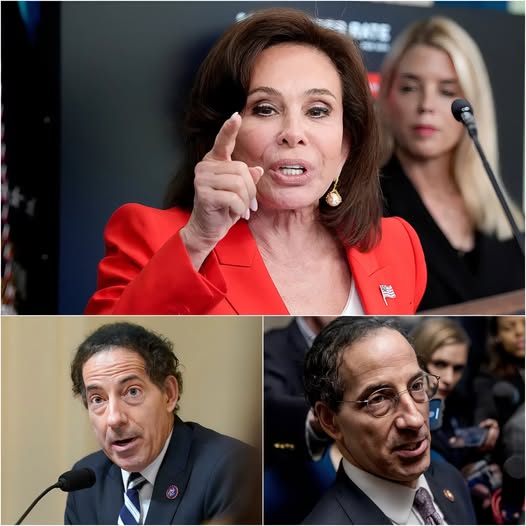
Pirro Demands Answers on Raskin’s $30 Million Fortune Former prosecutor Jeanine Pirro is publicly questioning Representative Jamie Raskin, demanding an explanation for an alleged $30 million increase in his net worth within two years. She calls for forensic audits, asserting that Raskin’s resistance to scrutiny and the unexplained wealth warrant a “serious investigation” or “grand jury.”
Former prosecutor Jeanine Pirro has ignited a fierce debate in Washington D.C. by publicly scrutinizing Representative Jamie Raskin’s reported $30 million net worth increase over less than two years. Pirro contends that such a rapid accumulation of wealth, coupled with Raskin’s repeated refusals to undergo an independent forensic audit, raises serious concerns about transparency and potential financial impropriety. She stresses that elected officials must be held to the highest ethical standards, and unexplained gains, especially when audit requests are resisted, warrant a thorough investigation to ensure public trust.
The controversy quickly captured national media attention, drawing commentary from both conservative and liberal outlets, and polarizing public opinion on social media. Supporters of Pirro applauded her demands for accountability, framing them as courageous and essential for government integrity. They argue that robust oversight is critical, especially when significant financial shifts occur in high office. Conversely, critics dismissed Pirro’s actions as ‘political theater,’ suggesting the allegations are more performative than substantive and are designed to create a media spectacle rather than address verifiable wrongdoing. Despite the backlash, Pirro has maintained her stance, emphasizing that the ultimate goal is to uncover the truth for the American public.
Legal experts weighed in on the procedural aspects, noting that while unexplained wealth alone is not necessarily a crime, combining it with resistance to audits raises significant ethical questions. They highlighted the possibility of a grand jury examining evidence of such increases, though establishing intent or misconduct would require detailed documentation. Pirro has stressed that her focus is not partisan but rooted in principle, advocating for any public servant’s financial dealings to be open to examination. She underscored that Raskin’s silence on an audit only fuels speculation, creating a perception of secrecy that undermines confidence in his financial transparency.
Washington insiders observed that these allegations could significantly impact Raskin’s political standing. Even if no legal wrongdoing is ultimately proven, the perception of opacity could influence public trust, affect his committee assignments, and potentially impact future electoral prospects. Raskin’s office has so far avoided detailed commentary, citing ongoing review and legal consultation, a strategy that some observers believe can exacerbate speculation. Pirro’s persistent advocacy, including setting an implicit three-day window for response, underscores her belief that accountability should not be optional and that resisting independent review only fosters public doubt.
The unfolding situation highlights broader concerns about wealth accumulation and influence in politics, underscoring the critical role of transparency mechanisms like voluntary audits in maintaining legitimacy. Analysts suggest that how Raskin chooses to engage with a forensic review could set new precedents for accountability among public officials. The case exemplifies the complex interplay of ethics, law, and political communication, where public scrutiny, media amplification, and partisan perspectives converge to influence both perception and potential institutional responses to allegations of unexplained financial gains. Ultimately, the controversy reinforces the societal demand for integrity in government, illustrating how vigilance and procedural examination are essential for maintaining public confidence in elected representatives.