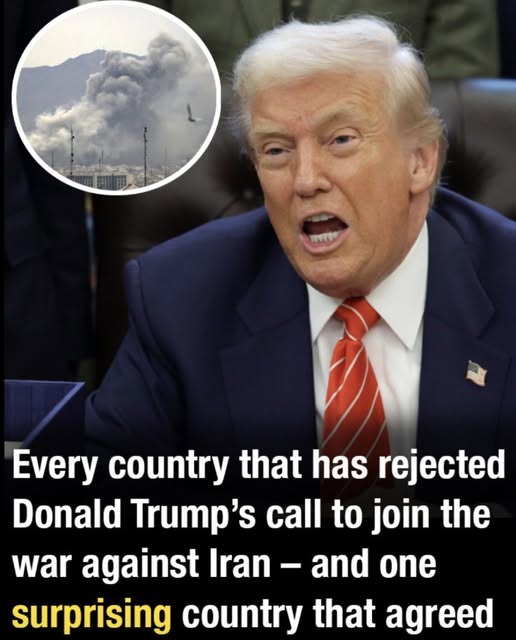
HERE WE GO: Iran just responded back…
Iran’s response was swift and multifaceted. Within hours, the IRGC launched waves of ballistic missiles and drones targeting Israel directly, as well as U.S. military bases across the region-including Al Udeid in Qatar, Al Dhafra in the UAE, the Fifth Fleet headquarters in Bahrain, Ali Al Salem in Kuwait, and sites in Jordan, Iraq, and Saudi Arabia. Explosions were reported in multiple Gulf capitals, heightening fears of a broader regional war engulfing U.S. allies. Most alarmingly, Iran’s IRGC Navy escalated by issuing urgent warnings via VHF Channel 16 to commercial vessels in the Persian Gulf. Multiple ships reported receiving explicit broadcasts declaring: \”No ship is allowed to pass the Strait of Hormuz,\” with messages labeling passage \”not allowed,\” \”unsafe,\” or \”banned for all ships of any type.\” The EU’s Operation Aspides naval mission and UK’s Maritime Trade Operations (UKMTO) confirmed these reports, describing them as the IRGC effectively claiming the strait closed. Iranian state-linked media, including Tasnim News Agency, stated the waterway was \”practically closed\” due to the \”insecure atmosphere\” from U.S.-Israeli aggression and Iran’s retaliatory actions.
While Tehran has not issued a formal, nationwide blockade decree-likely to avoid self-inflicted economic damage-the IRGC’s actions have already disrupted maritime traffic. Tanker tracking data from firms like Kpler and Bloomberg show vessels making U-turns, slowing, stopping, or rerouting around the strait. Major oil companies, trading houses, and LNG shippers-including some of the world’s largest-have suspended shipments through the passage. Some owners instructed fleets to avoid Hormuz entirely, while others advised proceeding with extreme caution. The U.S. Navy issued advisories that it could not guarantee commercial vessel safety in the Persian Gulf, prompting widespread hesitation.
The Strait of Hormuz is no ordinary waterway. This narrow chokepoint-only about 21 miles wide at its narrowest-connects the Persian Gulf to the Gulf of Oman and the Arabian Sea. It handles approximately 20-21 million barrels of crude oil and refined products per day, equating to roughly one-fifth of global oil consumption. Significant volumes of liquefied natural gas (LNG) from Qatar also transit here. Key exporters reliant on the strait include Saudi Arabia, Iraq, the UAE, Kuwait, and Qatar. Any sustained disruption would force rerouting around Africa or reliance on limited pipeline alternatives, massively increasing costs and delays.
Iran’s Blockade: Threat or Reality?
Historically, Iran has repeatedly threatened to close the strait during crises-most notably in 2019 amid U.S.